
MY LAST post was about the power one can feel avoiding supermarket plastic packaging and going to a refill store using containers from home to stock up.
This one is about how powerless and furious the pieces of plastic pictured above make me feel. I can’t even fit them all in the photo proportions WordPress requires.
This ludicrous array of 54 pieces, which could be an art installation shortlisted for the Turner Prize, was what John Lewis thought necessary to encase 36 curtains rings I needed for two windows.
I ordered online when I might normally try independent shops because it was Lockdown 2.0 and ‘non-essential’ shops were closed.
I wished I’d paid more attention and looked harder to buy them elsewhere now but I was in a hurry (the universal excuse for convenience) and was buying other items from their website. But all that is, frankly, a BoJo-poor excuse for not boycotting this kind of nonsense.
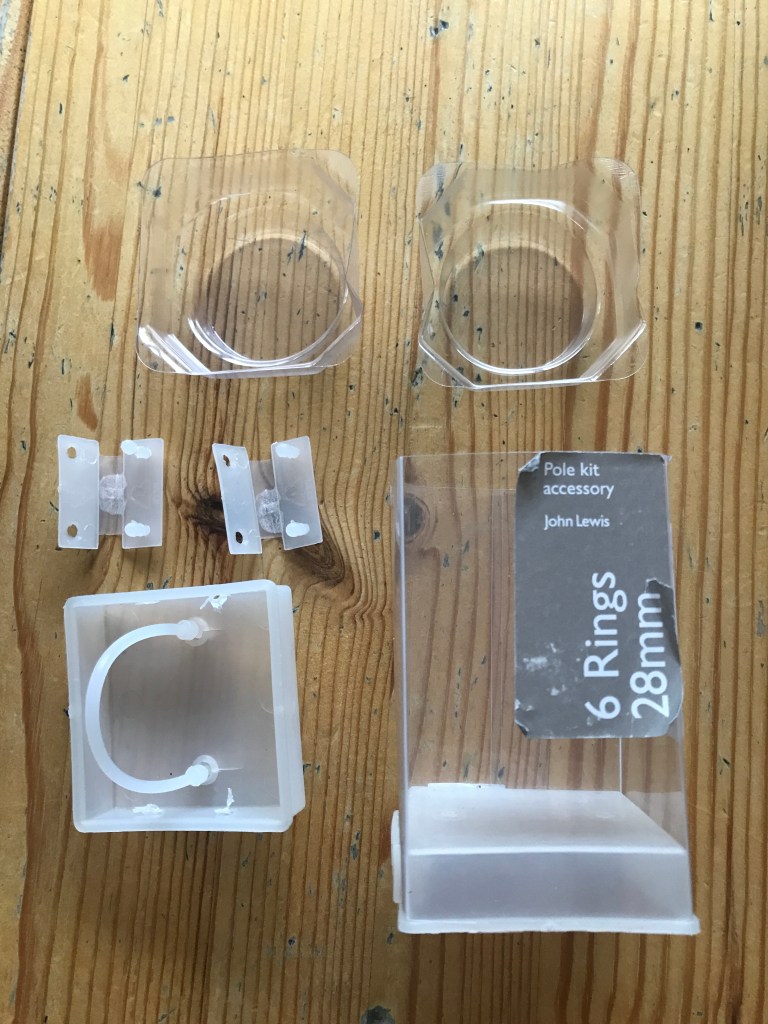
So here are the ingredients John Lewis uses for packaging just six curtain rings. Yes, SIX.
- One thin plastic box with a white plastic base
- One white plastic top with small handle
- Two thin plastic inserts so the rings can sit in the box
- Two white plastic hinges on the top of the box
- Two white plastic hinges on the bottom of the box
That is nine pieces of plastic for six rings.
Multiply that by the six boxes I needed just to hang curtains at two windows.
It comes to 54 bits of plastic.
And NOT A SINGLE ONE HAS A RECYCLING SYMBOL ON IT. (Sorry to shout, but for God’s sake!)
Honestly, there must be another way. They’re not foodstuffs that must be sealed away from contamination. They’re not fragile, requiring specialist packaging. They’re sodding curtain rings which could be put in a paper bag.
In the ‘Our commitments’ section of its website, John Lewis trills: ‘Reducing the amount of physical waste our business produces through operations, sales of goods and services, food waste or plastic packaging, is vital to prevent further environmental damage, food scarcity, and climate change breakdown.’
So I filled in one of those ghastly online ‘customer service’ forms companies use to channel people’s genuine annoyance into bite-size parcels.
Essentially, I asked why there was so much non-recyclable plastic in such a simple item.
And here’s what they said, without the editing it badly requires:
‘I understand that you have a concern with regard to our packaging, how we use natural resources and the waste we produce is a serious concern for both our Partners and customers.
When it comes to the environment, our aim is clear: we are committed to being part of the solution rather than part of the problem. We are committed to using natural resources as efficiently as possible and reducing our environmental impact. Because, by delivering more with less, we’ll help to protect both our business and the environment for generations to come.
Feedback like this helps us constantly improve our customer experience by knowing what we are doing right and what we can work on. So, I appreciate you taking the time to send us this helpful response.
Please be assured I will be passing on your feedback to the relevant parties, so that they will hear your voice.’
This sort of unsatisfying response has become the hallmark of how big business (even if they are all partners at John Lewis) answers genuine concerns from a customer.
It’s a standard system:
- Lightly personalise from drop-down menu areas to reflect the query (here: packaging / environment), leaving an ungrammatical sentence because you can’t be bothered / there’s not enough time to check it back
- Paste in the rest about blah blah constantly improve blah blah pass on feedback. Tick. Answered.
I’ll put a reminder on the calendar to check again in 12 months whether this nonsense packaging is still being used.
It takes real dedication to be this annoyed – if more of us did it, companies would be forced to make more effort to reform their practices. Possibly.
UPDATE / 23 DECEMBER 2020:
John Lewis has responded to my Instagram post by addressing the following points ‘direct from our buying team’.
Recycling – all the pictured elements are made with recyclable plastic. The frosted caps are PP and the tubes/ inserts are PET; these are both collected at the kerbside for recycling. For our new rebranded stickers we include full recycling instructions. Sadly, it looks like you received a product in our older packaging which is being phased out.
Sustainable sourcing – the stickers are made with FSC certified paper. The plastic used is made with 70% post-consumer recyclate [material which has been recycled]. We save 440,000 plastic bottles a year from going to landfill by using 70% recyclate in a proportion of our ready-made blind and curtain pole packaging. We are currently working on increasing this to 100% recycled content.
Packaging reduction – we have removed 742.5kg of plastic from production each year in blinds by switching the end cap at the top of the tube to an envelope fold. We plan to implement learnings from this elsewhere in the department. As highlighted, curtain rings would be a perfect example where we can further reduce our packaging.
While we are making great strides in this area, there is always room for improvement so thank you for bringing this to our attention.
 Rebecca Maer